The Fall of El Mencho. What the Killing of Mexico's Most Wanted Drug Lord Tells Us About Cartels, Power, and the War on Drugs
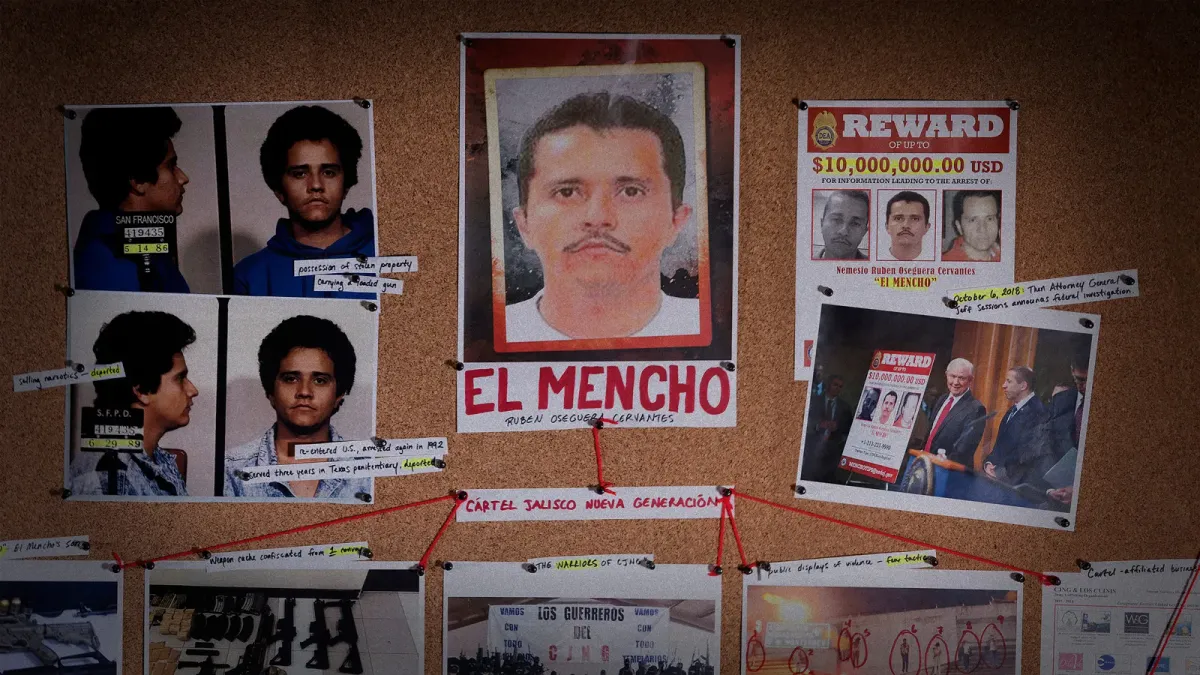
I. Who Was El Mencho?
On February 22, 2026, Mexican special forces killed Nemesio Rubén Oseguera Cervantes in the mountain town of Tapalpa, in the western state of Jalisco — ending the life of one of the most feared and powerful drug lords in modern history. Known by his alias 'El Mencho,' Oseguera Cervantes was the founder and supreme leader of the Jalisco New Generation Cartel (CJNG), an organization that the U.S. State Department has described as the most violent drug trafficking organization currently operating in Mexico.
El Mencho rose from humble origins in the coastal state of Michoacán. He was previously arrested in California in the 1990s on heroin trafficking charges and deported to Mexico, where he leveraged existing criminal networks to build what would become a narco empire. He spent years working under Ignacio 'Nacho' Coronel, a major figure in the Sinaloa Cartel, before breaking away to found the CJNG circa 2010 — a split made possible by the fragmentation of rival organizations following Mexico's intensified kingpin strategy.
The U.S. Drug Enforcement Administration (DEA) had placed a $15 million bounty on El Mencho — equal to the reward once offered for Osama bin Laden — making him America's most-wanted drug trafficker. In 2025, the Trump administration formally designated the CJNG as a foreign terrorist organization, a label previously applied to groups like Al-Qaeda and ISIS, reflecting the cartel's unprecedented level of violence and strategic sophistication.
II. How CJNG Operated: A Modern Criminal Empire
To understand the significance of El Mencho's death, one must first understand the organization he built. The CJNG was not a traditional street gang or even a conventional cartel. Analysts describe it as a franchise-based criminal enterprise that combined military discipline, sophisticated logistics, and extreme violence to dominate territory across Mexico and establish distribution networks in over 30 countries.
Military-Grade Arsenal
The CJNG became notorious for its use of military-grade weaponry at a scale rarely seen among non-state actors. When Mexican troops raided El Mencho's location in Tapalpa, they seized armored vehicles, rocket-propelled grenades, and rocket launchers capable of downing aircraft — the same type of weapon the CJNG used in 2015 to shoot down a Mexican military helicopter during a federal operation in Jalisco. The cartel has also deployed armed drones as offensive weapons, marking a disturbing evolution in criminal tactics.
Franchise Structure and Territorial Control
Unlike the more centralized Sinaloa Cartel, the CJNG employed a loose franchise model. Regional operators were granted relative autonomy to run their territories, provided they paid tribute to the central organization and adhered to CJNG branding and rules of conduct. This structure made the cartel both resilient and adaptable — difficult to decapitate because power was distributed, yet unified enough to coordinate mass responses like the nationwide roadblocks seen after El Mencho's death.
The Fentanyl Pipeline
The CJNG became one of the dominant forces in fentanyl trafficking into the United States — a drug roughly 100 times more potent than morphine and responsible for tens of thousands of American overdose deaths annually. The DEA has identified the cartel as a top supplier of illicitly manufactured fentanyl, often produced in clandestine laboratories using precursor chemicals sourced from China. The U.S. Customs and Border Protection reported seizing 11,500 pounds of fentanyl at the southwest border in fiscal year 2025 alone, much of it traceable to CJNG-linked networks.
III. The Operation That Killed El Mencho
The killing of El Mencho was the product of years of intelligence work by both Mexican and American agencies. On February 20, 2026, acting on information derived from surveillance of a close associate linked to one of El Mencho's romantic partners, Mexican authorities began quietly surrounding a property in Tapalpa — a small town roughly two hours southwest of Guadalajara. The operation involved special forces, the National Guard, military aircraft, and helicopters.
In the pre-dawn hours of February 22, troops launched the raid. Cartel gunmen immediately opened fire, and El Mencho and members of his inner circle fled to a nearby cabin complex, where a second firefight erupted. Soldiers eventually located a wounded El Mencho alongside two bodyguards. He was airlifted toward Mexico City but died during the flight. Seven people total were killed in the operation, including the cartel leader. Three Mexican soldiers were wounded.
White House Press Secretary Karoline Leavitt confirmed that the United States provided intelligence support for the operation, and a U.S. defense official told Reuters that a military-led intelligence task force focused on drug cartels had assisted in tracking El Mencho's location. U.S. Deputy Secretary of State Christopher Landau hailed the killing on social media, calling it 'a great development for Mexico, the U.S., Latin America, and the world.'
IV. The Cartel Strikes Back: Anatomy of a Retaliatory Response
What happened in the hours after El Mencho's death offers a revealing window into how powerful cartels function as quasi-governmental entities capable of paralyzing entire regions. Within hours of the killing becoming public, suspected CJNG members erected roadblocks in over 20 Mexican states, burning vehicles to block highways and military movements. Guadalajara — Mexico's second-largest city, with a population of over five million — effectively shut down as frightened residents stayed home and public transport was suspended.
El Mencho's right-hand man, a figure known as 'El Tuli,' was quickly identified by Mexico's Defense Ministry as the organizer of the retaliatory attacks. He allegedly offered bounties of 20,000 pesos (roughly $1,100) for each soldier killed. He was himself tracked down later that same day in a small town 180 kilometers from Guadalajara and killed during a confrontation with security forces — a testament to the speed and coordination of the government's response. In total, over 25 members of the National Guard were killed in Jalisco in the aftermath of the operation.
The violence forced the U.S. Embassy to issue shelter-in-place warnings for American citizens across multiple Mexican states, including popular tourist destinations like Puerto Vallarta and Cabo. Airlines cancelled flights, and rideshare services were suspended. The events demonstrated that a modern cartel, even after losing its leader, retains the infrastructure and will to project power on a national scale.
V. Political Context: Pressure, Sovereignty, and the Kingpin Debate
El Mencho's killing did not occur in a political vacuum. Since Donald Trump's return to the U.S. presidency in January 2025, his administration has mounted intense pressure on Mexican President Claudia Sheinbaum to take more aggressive action against drug trafficking organizations. Trump threatened tariffs, sanctions, and even direct U.S. military action on Mexican soil — a position that created significant diplomatic friction with a country that jealously guards its sovereignty.
Sheinbaum, for her part, had been critical of the 'kingpin strategy' — the approach of targeting cartel leaders — practiced by previous Mexican administrations. The evidence for her skepticism is substantial: the arrest of Sinaloa Cartel founder Joaquín 'El Chapo' Guzmán in 2016, widely celebrated as a major victory, was followed by a surge in violence as successor factions fought over his territory. Critics of the kingpin strategy argue that decapitating an organization without dismantling its financial networks, supply chains, and political protections creates a power vacuum that new, often more violent actors rush to fill.
Nevertheless, under pressure from Washington and seeking to demonstrate security credentials ahead of Mexico hosting matches for the 2026 FIFA World Cup, the Sheinbaum government greenlit the operation. Mexican analysts note that since she took office, the army has adopted a more confrontational posture against criminal groups. This shiftulminated in the killing of El Mencho, described by many as the most significant blow against organized crime in Mexico since El Chapo's recapture in 2016.
VI. Does Killing Cartel Leaders Work? The Broader Implications
El Mencho's death raises a question that has preoccupied drug policy scholars and law enforcement officials for decades: Does killing or arresting the leaders of criminal organizations actually reduce drug trafficking, violence, or addiction?
The historical record is sobering. The Medellin Cartel effectively ceased to exist after Colombian authorities killed Pablo Escobar in 1993 — but cocaine trafficking from Colombia did not decline. It merely reorganized into new groups, such as the Cali Cartel, and later into smaller, more decentralized outfits. In Mexico, the aggressive kingpin strategy pursued under President Felipe Calderón (2006–2012) succeeded in eliminating numerous high-profile targets b. Still, it coincided with a dramatic escalation of overall violence, as cartels fragmented and fought over the resulting power vacuums.
Experts like Jake Braun, former senior counselor to the U.S. Secretary of Homeland Security, argue that leadership takedowns must be layered within a 'full counter-network approach' that simultaneously targets brokers, financiers, and transportation infrastructure. Similarly, criminologist Nikos Passas of Northeastern University notes that the CJNG is unlikely to collapse following El Mencho's death — the cartel has sufficient organizational depth, financial reserves, and regional leadership to survive the loss of a single figure, however central.
El Mencho's likely successor is believed to be a figure known as 'El Pelón,' the cartel boss's stepson, who was federally indicted in the U.S. on cocaine and methamphetamine trafficking charges in 2020. Meanwhile, rival organizations — most notably the weakened but resilient Sinaloa Cartel — may seek to reclaim territory previously seized by the CJNG, potentially triggering a new round of inter-cartel conflict.
The broader lesson may be this: cartels are ultimately market actors responding to the enormous economic incentives created by drug prohibition and American consumer demand. So long as those underlying conditions persist, the drug trade will find new leaders, new routes, and new methods to satisfy a multi-billion-dollar market.
Conclusion
The killing of El Mencho is a genuinely significant event — a hard-won tactical success for Mexican and American law enforcement, and a symbolic blow against one of the world's most dangerous criminal organizations. It reflects improving intelligence cooperation between the two nations and demonstrates that even the most protected drug lords are ultimately reachable.
But to treat it as a decisive victory in the war on drugs would be to misread both the nature of the problem and the lessons of history. The CJNG will reorganize. Fentanyl will continue to flow. The families of the disappeared in Jalisco will continue to search. A sound understanding of what happened on February 22, 2026, requires holding two truths simultaneously: that the death of El Mencho matters, and that it is not enough.
Fact-Check Sources
All claims in this essay are sourced from reputable news organizations and government statements. Readers are encouraged to verify independently.
• CBS News — El Mencho background and killing: https://www.cbsnews.com/news/el-mencho-nemesio-ruben-oseguera-cervantes-jalisco-new-generation-cartel-history/
• CBS News — Violence in Mexico after killing: https://www.cbsnews.com/news/violence-mexico-jalisco-new-generation-cartel-killed-military-puerto-vallarta/
• Al Jazeera — How the operation unfolded: https://www.aljazeera.com/news/2026/2/24/the-killing-of-mexican-drug-lord-el-mencho-how-it-unfolded
• Al Jazeera — Will CJNG survive El Mencho's death?: https://www.aljazeera.com/economy/2026/2/25/will-mexicos-jalisco-cartels-violent-biz-model-survive-el-menchos-death
• NBC News — Cartel unleashes wave of violence: https://www.nbcnews.com/world/mexico/jalisco-new-generation-cartel-leader-killed-rcna260184
• Northeastern University — Expert analysis on cartel implications: https://news.northeastern.edu/2026/02/25/el-mencho-death/
• ABC7 Chicago — What comes next for drug trafficking: https://abc7chicago.com/post/el-mencho-dead-what-comes-notorious-drug-boss-leader-jalisco-new-generation-cartel-killed-mexican-military/18655190/
• Axios — Other cartel leaders still sought by U.S.: https://www.axios.com/2026/02/25/mexico-cartel-leaders-el-mencho-us-drug-trafficking
• CNN — Travel chaos and shelter-in-place warnings: https://www.cnn.com/world/live-news/mexico-el-mencho-killed-travel-chaos-02-23-26-intl-hnk